How reaching out to strangers can keep trans travellers safe
Reading about a destination is merely the beginning of being prepared. IRL contacts are the best (and coolest?) way for trans travellers to stay saf
Written by
Evan E. Lambert
June 24, 2026 last updated July 10, 2026
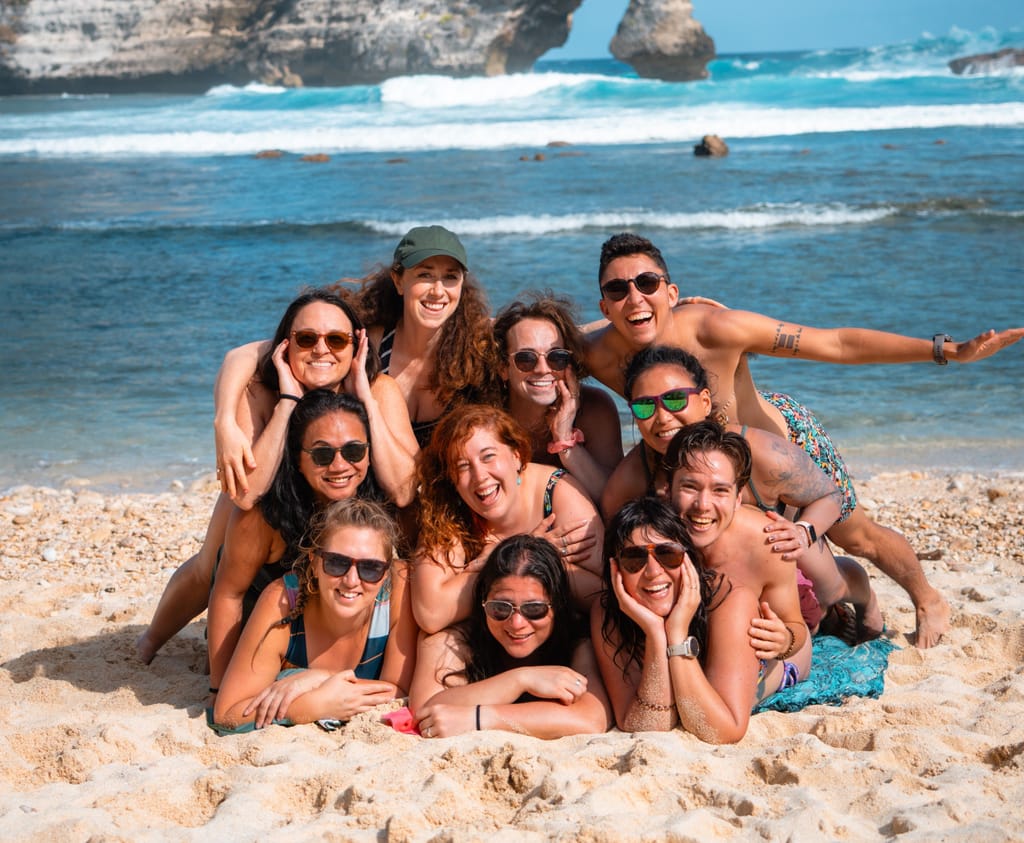
Ten cheerful friends are enjoying a sunny day together, posing on a beautiful sandy beach by the clear blue ocean.
When Sonali Khan arrived at her Airbnb in Goa, India, she wasn’t expecting trouble. Scenic views and arresting Portuguese-inspired architecture, perhaps, but certainly not a housing crisis on her very first day. Her friend had already booked the house. The reservation was confirmed. There was nothing left to do.
Then the Airbnb host realized Sonali and her friends were transgender.
“The owner looked at me and said, ‘We cannot give the Airbnb to you because you’re trans,’” says Khan. “She said, ‘We have kids here, and people like you…. There are neighbours that might not be okay with it. Personally, we do not entertain people like you.’”
Advertisement
Sonali and her friends explained that they had already booked the place and were not about to cancel, but the owner still refused to give them the key.
“We had to leave with all of our luggage and everything,” says Khan. “We were on the street with our luggage, roaming around looking for another place.” This was particularly stressful in the country with the highest murder rate of trans people in all of Asia.
A cis member of the group booked another house in the city and retrieved the key for the group. Later, her friend, who booked the first house, was able to receive a full refund through Airbnb after elevating their complaint to a discrimination case. “Airbnb themselves seemed shocked that we were denied simply because we are transgender,” says Khan, who is atrans rights activist based in India and a member of the Gender Diverse Travel Advisory Group for the International LGBTQ+ Travel Association (IGLTA), though in this interview she speaks for herself, not for the group.
Advertisement
Unfortunately, this kind of situation is not uncommon for trans travellers, who must take more precautions than their cis counterparts. To maintain their own safety, they must constantly make strategic decisions shaped by identity, privilege and a need for community. Researching a country or region in advance of a trip is merely the first step. Reaching out to locals, and building a community in a destination, can keep a traveller safe and make a trip more meaningful.
Khan says she now checks in advance if a hotel accepts trans guests. “Whenever I’m booking any accommodation, I always make sure that I email them to let them know that I’m a transgender woman, and ask if it is okay that my legal gender in my document is trans.”
Dubbs Weinblatt, a New York City–based educator, facilitator, speaker, podcaster and the founder and CEO ofThank You For Coming Out, says their process of preparation is just as intense. “I search if a city is LGBTQ+ or trans friendly, if it has anti-trans laws, bathroom bills, things like that,” Weinblatt says. “I look up whether there’s an LGBTQ+ centre.”
Advertisement
Dubbs Weinblatt is the founder of Thank You For Coming Out. Credit: Dubbs Weinblatt
The IGLTA Foundation’sTrans & Gender Diverse Travel Guide echoes this advice, urging any traveller visiting a new country to first research laws about gender identity, expression, bodily autonomy, “cross-dressing,” “public decency” or other laws with similar wording. It even suggests pre-planning strategic breaks while on road trips to avoid stopping in potentially unfriendly rural areas. Weinblatt also suggests followingErin in the Morning, a news and resource platform created by a trans journalist that often provides travel advisories.
Kayley Whalen, a trans traveller and anthropology Ph.D. student at University of California, Davis, says that travel advice for trans people often devolves into fear management. “If you make your travel decisions based on statistics and fear,” she says, “you’re never going to travel.”
Whalen says that reporting on certain countries, such as Brazil, is often reduced to alarming headlines about trans-related violence, without context or nuance.
Advertisement
“A lot of trans people focus on the really high number of trans people who have been killed in Brazil, and they’re like, ‘I’m definitely not going to go there,’” she says. “I’m not going to tell a bunch of trans people, like, Brazil is safe. Certainly it’s not. But the U.S. isn’t safe either. So where is safe, versus where do you just take precautions and be aware of your surroundings?”
Whalen suggests contacting locals rather than relying solely on travel media reporting, which doesn’t always consider trans perspectives. “I don’t just look at non-discrimination laws and say, ‘Okay, this place isn’t safe. You’re rarely going to find the information you need in a tour guide. You’re going to have to ask people.”
Her first step is often identifying local LGBTQ+ organizations and community groups. “I look up: what’s the local LGBTQ+ centre? What’s the local LGBTQ+ human rights group? Then I say, ‘Hey, I’d love to meet with you.’”
Advertisement
Facebook Groups are one way to meet people and do research, as are social networking apps likeQuouch, which pairs queer travellers with queer hosts. Gender-diverse travellers often prefer Quouch to misterb&b due to its higher number of trans users. Meanwhile, the queer-friendly dating app Feeld and the queer friends-and-dating app Lex are both cited as effective tools for meeting other trans people while abroad.
Whalen also meets other trans people by participating in group outings. “There’s this amazing Airbnb experience tour guide who works at a cabaret show in Bangkok. She’ll take you to tell you her life story. She’ll show you a cabaret show and introduce you to other trans folks.”
Such programming is essential in certain cities where queer social spaces aren’t necessarily trans social spaces.
Advertisement
“I always try to figure out if there’s an LGBTQ+-friendly neighbourhood, or even just a gay bar. Although, as a woman, this sometimes backfires, because in some places, that little rainbow flag on the door just means it’s ‘gay male.’ Not necessarily lesbian, bi or trans-friendly,” saysAdriana Roberts, a San Francisco–based performer, DJ and founder of the nightlife and music brand Bootie Mashup. She says she encountered this disconnect in both Japan and Germany.
Roberts says she worries less about safety while travelling because she “passes” as cis. “The grim, shitty reality of it all is this,” she says. “The more you ‘pass,’ the easier it is to travel. There, I said it. It sucks. But I can’t tell you how much easier my life got, especially while travelling, when I started looking and sounding less nonbinary androgynous and more conventionally female-bodied.”
Roberts still worries about street harassment in countries where that phenomenon is normalized. “The only difference is, I don’t want to get hate-crimed by a straight guy who ends up having a ‘gay panic’ if they figure out I’m transgender.”
Advertisement
Sam Goldon, who forms one half of the Alaska-based travel influencer duo@thegoldonqueers, also feels pressured to pass sometimes. “Now that my licence says M, I'll lower my voice and pull my shoulders back and have that generally unbothered attitude that cis men have, just to try and play the part better,” they say. “I don’t like admitting that, but sometimes our safety has to come first, you know?”
Not all trans people possess passing privilege, or even equal access to resources. Khan says that as someone from a developing country, she has to do extra research before a trip. “If you go to misterb&b, it is very, very expensive. If you see it from the perspective of an Asian person, it is just too expensive to afford for one night,” she says. “That is the only reason we have to look for less-expensive alternatives, and that is why I have to email them to check if they are friendly.”
Gabrielle Claiborne, an Atlanta-based activist, speaker, business owner and chair of IGLTA’s Gender Diverse Travel Advisory Group, the mere act of walking outside can cause apprehension. “Every time I walk out of my house, I am preparing myself for the worst,” she says. “I see the glances, I see the snickering. I see you whispering to your neighbour and looking at me. I’m not stupid. I know what you’re doing.”
Advertisement
Gabrielle Claiborne is chair of IGLTA’s Gender Diverse Travel Advisory Group. Credit: Gabrielle Claiborne
Goldon says there are overlapping layers of privilege within the nomadic trans community. “As a white, English-speaking person with a U.S. passport, I do feel like I have quite a bit of privilege when travelling abroad in so many ways, and it does make me feel safer as a trans person, too.”
Whalen, who has traveled to 37 different countries, still believes that it’s essential for all trans people to travel, no matter their additional risks or safety concerns.
“You’re an ambassador as a traveller,” she says. “If you go to a country being like, ‘Oh, your country is so awful to trans people,’ you’re not helping trans people in that country. But when you go to a country that maybe isn’t up there on human rights, and you meet with trans people and see, like, ‘Wow, look at all these trans people who are thriving and who are fighting for their rights.’ Then you go, ‘Okay, clearly laws and culture are two different things.’”
Advertisement
Travelling while out and proud, though not for everyone, is one way of raising trans visibility.
“Trans people have always existed, all over the world, in every small town and big city, out and embraced by many or quietly living their truths,” says Goldon. “We deserve to move among the rest of the world in peace, safety and pride.”
How this trans-owned Toronto café became a global destination
Since opening in early 2026, Toronto’s Understory has had customers from Madagascar to Russia. We talked to co-owner Rowan Jetté Knox about the vision for the café
Clothing-optional gay beaches are a refuge for our community. But these six are facing serious threats, environmental, legal and otherwise, that could take them away from us